Medically reviewed by Dr. Shyam D, M.Ch (Neurosurgery), FACS, IFAANS — Consultant Neurosurgeon, Manipal Hospital Electronics City
A sharp, burning pain that shoots from your lower back down the buttock and into the leg — sometimes all the way to the foot — is one of the most common reasons people visit a spine surgeon. In most cases, the cause is a disc prolapse pressing on a nerve root, a condition commonly called sciatica.
The good news: most people with sciatica from a disc prolapse get better without surgery. The important part is knowing which symptoms can safely be treated at home, which need a specialist, and which are an emergency.
This guide explains why disc prolapse causes leg pain, the treatments that work, and the clear signs that tell you surgery is the right step.
Why Does a Disc Prolapse Cause Leg Pain?
Between each vertebra in your spine sits a disc — a tough outer ring with a soft, jelly-like centre. With age, repeated strain, lifting or prolonged sitting, the outer ring can weaken and the inner material can bulge or push out. This is a disc prolapse (also called a slipped disc or herniated disc).
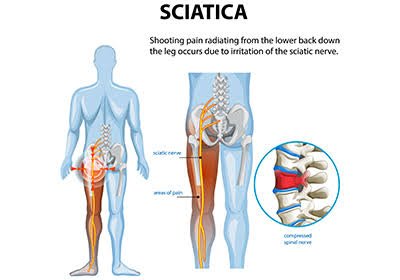
When the prolapsed disc presses on a nerve root in the lower back, the pain is felt along the path of that nerve — down the leg, not just in the back. That is why leg pain is often worse than back pain in disc prolapse.
The level of the disc decides where you feel it:
| Disc level | Nerve affected | Where you feel pain or numbness |
|---|---|---|
| L3–L4 | L4 | Front of thigh, inner shin, knee |
| L4–L5 | L5 | Outer leg, top of foot, big toe |
| L5–S1 | S1 | Back of calf, sole, outer foot, little toes |
L4–L5 and L5–S1 are by far the most commonly affected levels.
For a full overview of disc problems, read Slipped Disc — Do You Really Need Surgery? An Honest Guide.
Common Symptoms of Sciatica from Disc Prolapse
- Shooting, electric or burning pain from the buttock into the leg
- Pain that worsens on sitting, bending forward, coughing or sneezing
- Numbness or tingling (“pins and needles”) in the leg or foot
- Weakness — difficulty lifting the foot, walking on heels or toes
- Pain usually affecting one leg
- Back pain that may be mild compared to the leg pain
🚨 Emergency Signs — Seek Care Immediately
Go to the emergency department or call a neurosurgeon the same day if you have:
- Loss of bladder control or difficulty passing urine
- Loss of bowel control
- Numbness in the groin, inner thighs or around the back passage (“saddle numbness”)
- Sudden weakness in both legs
- Foot drop that is new or rapidly getting worse
These can be signs of cauda equina syndrome or severe nerve compression. Delays of even a few hours can affect permanent recovery.
How Sciatica Is Diagnosed
- Clinical examination — checking muscle strength, reflexes, sensation and the straight leg raise test
- MRI of the lumbar spine — the best test to see the disc, the nerve and the degree of compression
- X-rays — sometimes taken to check alignment and stability
- Nerve conduction study — occasionally used when the diagnosis is unclear
An important point: the MRI must match your symptoms. Many people have disc bulges on MRI that cause no pain at all. Treatment is based on the combination of symptoms, examination and scan — not the scan alone.
You can send your MRI on WhatsApp for a prompt, honest second opinion.
Non-Surgical Treatment: Where Most Patients Start
For most people without weakness or emergency signs, the first 6–12 weeks are managed without surgery. A large proportion of disc prolapses shrink naturally over this time as the body reabsorbs the disc material.
1. Stay gently active
Bed rest for more than a day or two slows recovery. Short, frequent walks are better than lying down.
2. Medication
Your doctor may prescribe pain relievers, anti-inflammatory medicines and medicines specifically for nerve pain. Take them only as prescribed.
3. Physiotherapy
A structured programme of nerve-gliding exercises, core strengthening and posture correction helps relieve pressure and prevent recurrence.
4. Epidural steroid injection
A targeted injection near the irritated nerve root can reduce inflammation and pain. It does not remove the disc, but it can control pain while the disc heals naturally.
5. Lifestyle changes
- Avoid prolonged sitting — take a break every 30–45 minutes
- Lift with your knees, not your back
- Maintain a healthy weight
- Stop smoking, which accelerates disc degeneration
When Is Surgery Needed for Sciatica?
Surgery is recommended when the benefits clearly outweigh the risks. These are the situations where a spine surgeon will usually advise an operation:
1. Emergency nerve compression
Cauda equina syndrome (bladder or bowel loss, saddle numbness) needs urgent surgery, ideally within hours.
2. Progressive or significant weakness
If your foot or leg is getting weaker — for example, a new foot drop — delaying surgery risks permanent weakness.
3. Pain not improving after 6–12 weeks
If severe leg pain continues despite medication, physiotherapy and possibly an injection, surgery is a reasonable option.
4. Pain that stops you from living normally
Some patients cannot sit, sleep, walk or work because of the pain, even in the early weeks. In these cases, earlier surgery may be the right choice.
5. Repeated episodes
Recurrent attacks of sciatica from the same disc that keep disrupting your life may be best treated surgically.
Our principle: surgery is recommended only when it is genuinely the best option. Many patients who come for a surgical opinion leave with a non-surgical plan.
Surgical Options for Disc Prolapse
Modern disc surgery is minimally invasive. The aim is simple: remove only the piece of disc pressing on the nerve, while keeping the rest of the spine intact.
Microdiscectomy
The gold-standard operation for disc prolapse. Through a small incision of around 2–3 cm, the surgeon uses an operating microscope to gently move the nerve aside and remove the prolapsed fragment.
Endoscopic discectomy
Performed through an even smaller incision using a thin endoscope (camera). It causes very little muscle disruption and is suitable for selected disc prolapses.
Tubular discectomy
The disc is reached through a narrow tube that separates the muscles instead of cutting them — a key technique of minimally invasive spine surgery.
Is a fusion needed?
Usually not. A simple disc prolapse rarely needs fusion. Fusion is considered only when there is spinal instability, slippage of a vertebra or repeated recurrence at the same level. Learn more in our guide to minimally invasive lumbar fusion.
For a side-by-side comparison of techniques, see minimally invasive vs open spine surgery.
Recovery After Disc Surgery
| Time after surgery | What to expect |
|---|---|
| Same day / Day 1 | Walking within hours. Leg pain often improves noticeably soon after surgery |
| Day 1–2 | Discharge home for most patients |
| Weeks 1–2 | Daily walks, short periods of sitting. Wound review |
| Weeks 2–4 | Return to desk or work-from-home jobs for many patients |
| Weeks 4–6 | Begin guided physiotherapy and core strengthening |
| Weeks 6–12 | Gradual return to exercise, driving longer distances and physical work |
What improves first: leg pain usually improves the fastest. Numbness and weakness recover more slowly — sometimes over several months — as the nerve heals.
Preventing recurrence
- Keep up core-strengthening exercises long term
- Avoid heavy lifting and sudden twisting for the first few weeks
- Use an ergonomic workstation if you sit for long hours
- Maintain a healthy weight
Risks of Disc Surgery
Disc surgery is one of the most commonly performed and well-studied spine operations. Possible risks include:
- Infection (uncommon with small incisions)
- Dural tear (small spinal fluid leak, usually repaired at the time)
- Nerve irritation or injury (rare)
- Recurrent disc prolapse at the same level — a small proportion of patients
Your surgeon will explain how these apply to your individual case.
For general patient information, see MedlinePlus — Sciatica and the American Association of Neurological Surgeons.
Sciatica Treatment Near Electronics City, Bangalore
Dr. Shyam D is an internationally fellowship-trained neurosurgeon specialising in minimally invasive spine surgery. He consults at Manipal Hospital Electronics City, serving patients from HSR Layout, Sarjapur Road, Bommanahalli, Hosur Road and across South Bengaluru.
- M.Ch Neurosurgery with two university gold medals
- FACS and IFAANS
- Advanced training in Japan, the USA and Istanbul
- Non-surgical treatment first, wherever possible
- Minimally invasive surgery when it is genuinely needed
If you are struggling with pinched nerve pain in the lower back or back pain in Electronics City, an early assessment can prevent long-term nerve damage.
Frequently Asked Questions
Yes. Most patients improve within 6–12 weeks with medication, physiotherapy and activity changes, as the prolapsed disc material often shrinks naturally
Surgery is usually advised if you have bladder or bowel problems, worsening leg weakness or foot drop, or severe leg pain that has not improved after 6–12 weeks of proper non-surgical treatment
Get an Honest Opinion on Your Leg Pain
Not sure whether your sciatica needs surgery? Share your MRI and get clear, honest advice from a fellowship-trained neurosurgeon.
📞 Call / WhatsApp: +91 63802 71088 📍 Manipal Hospital Electronics City, Neeladri Road, Electronics City Phase 3, Bengaluru — 560100
This article is for general information only and does not replace a medical consultation. If you have bladder or bowel problems or sudden leg weakness, seek emergency care immediately.
3 Comments