Minimally invasive spine surgery (MISS) lets many spine problems be treated through incisions of just a couple of centimetres — sparing the back muscles, reducing pain, and getting you home and moving faster than traditional open surgery. Dr. Shyam D offers minimally invasive techniques for suitable cases, alongside honest advice on when a condition can be managed without surgery at all.
What is minimally invasive spine surgery?
Traditional open spine surgery uses a longer incision, with the back muscles pulled aside to give the surgeon a wide, direct view. Minimally invasive spine surgery reaches the same target through one or more small incisions, using a tubular retractor that parts the muscle fibres instead of cutting them, along with a microscope or endoscope for a magnified view and specialised long instruments — often guided by live X-ray imaging.
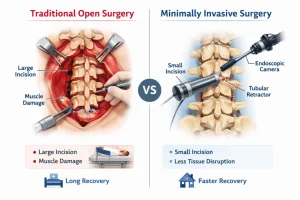
The surgical goal is identical — decompress a nerve, remove a disc fragment, stabilise a segment. What changes is the amount of tissue disruption needed to get there. Less collateral damage to the muscles means less pain and a quicker recovery.
For a fuller comparison of the two approaches, see our guide on minimally invasive vs open spine surgery.
Benefits of the minimally invasive approach
For suitable cases, MISS offers real, measurable advantages over open surgery:
- Smaller incisions and smaller scars
- Less muscle damage — the muscles are parted, not stripped from the bone
- Less blood loss during surgery
- Reduced post-operative pain and less need for strong painkillers
- Shorter hospital stay — some procedures are day-care or overnight
- Faster return to work and daily activity
- Lower infection risk and less scar tissue
The key qualifier: these benefits apply when a case is genuinely suited to the technique. MISS isn’t automatically better for every spine problem — and part of a good surgeon’s job is knowing when an open approach is the safer choice.
Conditions treated with minimally invasive spine surgery
Dr. Shyam D uses minimally invasive techniques, where appropriate, for:
- Herniated (slipped) disc — see our guide on slipped disc treatment
- Sciatica from a pinched nerve — see pinched nerve in the lower back
- Lumbar spinal stenosis — see lumbar spinal stenosis and decompression
- Nerve compression in the lower back or neck
- Spinal instability requiring fusion (single-level and select cases)
- Degenerative disc disease at one level
- Some spinal tumor biopsies and select tumor removals
Procedures offered
Minimally invasive discectomy Removing the fragment of a herniated disc that’s pressing on a nerve, through a small incision — one of the most common and most rewarding MISS procedures, often with rapid relief of leg pain.
Minimally invasive decompression (laminectomy) Reopening space around compressed nerves in spinal stenosis, relieving the leg pain and heaviness that limit walking.
Minimally invasive lumbar fusion Stabilising an unstable segment with screws and a cage through small incisions, for suitable single-level cases — with less muscle disruption than open fusion.
Endoscopic spine surgery Using an endoscope through a very small incision for a magnified view, in selected cases.
Who is a good candidate?
Minimally invasive techniques tend to suit:
- Single- or two-level disc herniations and nerve compression
- Spinal stenosis limited to one or two levels
- Straightforward single-level fusions
- Patients who benefit from minimising blood loss and recovery time — including older patients or those with other health conditions
Complex multi-level deformity, major revision surgery, and certain tumors or trauma are often better served by an open approach. The right choice depends on your specific scan and diagnosis — which is exactly what an assessment determines.
Most spine problems don’t need surgery at all
This is worth stating plainly on a surgery page: the majority of back and neck problems, including many slipped discs, improve with physiotherapy, medication, and time — no surgery of any kind. Surgery becomes the right conversation only once conservative treatment has been given a fair trial and the problem is genuinely limiting your life, or when there are red-flag symptoms.
Dr. Shyam D’s approach is to recommend surgery only when it’s genuinely the best option — and to say so clearly when it isn’t. If you come for an assessment and leave being told you don’t need an operation, that’s a good outcome.
Seek urgent care if you have loss of bladder or bowel control, numbness around the groin, or rapidly worsening leg weakness — these need immediate attention, not watchful waiting.
Recovery after minimally invasive spine surgery
Recovery varies with the procedure, but general patterns for minimally invasive cases:
- Hospital stay often same-day to a couple of days
- Walking encouraged within hours of surgery
- Many people return to light, desk-based work within 1–3 weeks
- Heavy lifting, bending, and twisting avoided in the early weeks
- Physiotherapy to rebuild strength and reduce recurrence
Your specific recovery plan is tailored to your procedure and health — this is a general guide, not a promise.
Why choose Dr. Shyam D
- Experienced in both minimally invasive and open spine techniques — so the recommendation fits the problem, not the tool
- Consulting at Manipal Hospital, Electronics City, with full imaging, theatre, ICU, and multidisciplinary support
- An honest, conservative-first approach — surgery only when it’s genuinely warranted
- Assessment, surgery, and follow-up in one place
- Convenient for patients across Electronics City, Bommasandra, Sarjapur Road, HSR Layout, and along Hosur Road
Frequently asked questions
Is minimally invasive spine surgery safe? Yes, when performed by an experienced, specifically trained spine surgeon. It typically involves less blood loss and lower infection risk than open surgery, but it demands particular skill because of the narrow working view.
How long is recovery after minimally invasive spine surgery? Many patients walk within hours and return to light work within 1–3 weeks, though full recovery depends on the exact procedure. Open surgery generally takes longer.
Is minimally invasive spine surgery better than open surgery? For suitable cases it offers less pain and faster recovery. But complex or multi-level problems may be safer with an open approach. The best method depends on your specific condition — see our comparison guide.
Will I need spinal fusion? Not always. Many problems are treated with decompression or discectomy alone. Fusion is used when the spine is unstable — and can often be done minimally invasively.
Does every slipped disc need surgery? No. Most improve with non-surgical treatment. Surgery is considered only when severe symptoms persist despite proper treatment, or when there’s significant weakness.
Where is the clinic located? Dr. Shyam D consults at Manipal Hospital, Electronics City, Bengaluru — accessible from across South and East Bangalore.
Book a consultation
If back or leg pain is limiting your life, or you’ve been told you may need spine surgery, a clear assessment will tell you whether minimally invasive surgery — or no surgery at all — is right for you. Book a Consultation · Send Reports on WhatsApp · +91 63802 71088
This page is for general information and is not a substitute for professional medical advice. Always consult a qualified neurosurgeon about your specific condition.