If you’ve been told you need spine surgery, you’ve probably already come across the term “minimally invasive” — usually presented as the obviously better option. It isn’t quite that simple. Both approaches can achieve the same surgical goal; what changes is how the surgeon gets there, and that difference has real consequences for recovery, risk, and — in some cases — how completely the underlying problem gets fixed.
This is a surgeon’s honest breakdown of what actually changes for the patient, not a sales pitch for either approach.
The core difference isn’t the goal — it’s the access
Open spine surgery and minimally invasive spine surgery (MISS) are often trying to accomplish the exact same thing: remove a herniated disc fragment, decompress a pinched nerve, stabilize an unstable segment with screws and rods, or remove a tumor. The difference is how the surgeon reaches the spine to do it.
Open surgery uses a single, longer incision, with the muscles along the spine retracted — pulled aside and held open — to give the surgeon a wide, direct view of the anatomy.
Minimally invasive spine surgery uses one or more small incisions (often under 2–3 cm each), with specialized tubular retractors or a surgical microscope/endoscope that dilate through the muscle rather than cutting or stripping it away. The surgeon works through this narrow corridor, often guided by intraoperative imaging or navigation, to reach the same target. You can read more about the specific techniques on our minimally invasive spine surgery page.
Neither approach is “better” in the abstract. The right one depends on what’s actually wrong with your spine.
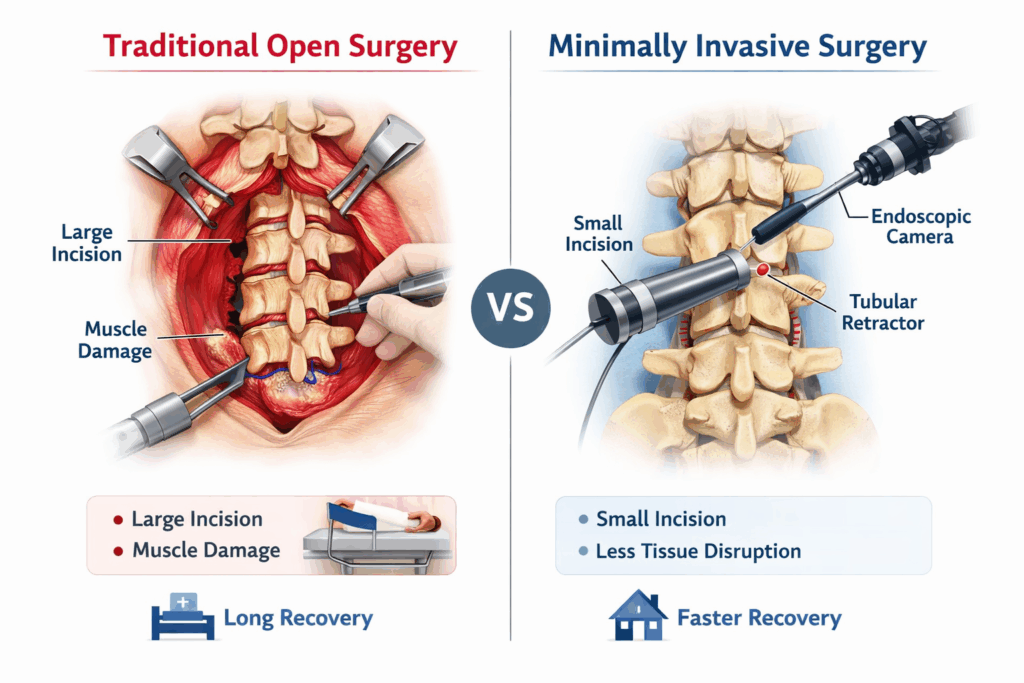
How each surgery actually happens in the operating room
It helps to picture what each involves, because the phrase “minimally invasive” can sound almost like a non-surgery. It isn’t — it’s the same serious operation reached a gentler way.
In an open procedure, once you’re under general anaesthesia, the surgeon makes the incision along the midline of the back and lifts the paraspinal muscles off the bone to expose the vertebrae. With a wide field in view, they carry out the decompression, disc removal, or fusion, place any screws and rods needed, then lay the muscle back and close in layers.
In a minimally invasive procedure, the surgeon first uses live X-ray imaging to pinpoint the precise level, then makes a small incision and passes a sequence of progressively wider tubes that spread the muscle fibres apart instead of cutting them. A final tubular retractor — often less than an inch across — holds this channel open. Working through it with a microscope or endoscope for magnified vision and long, narrow instruments, the surgeon performs the same decompression or fusion. Because the muscle is parted rather than stripped, there’s less tissue to heal afterward.
The surgical objective is identical. The route is what differs.
What actually changes for the patient
Muscle damage and post-operative pain
This is the biggest real difference, and it’s mechanical, not marketing. In open surgery, the paraspinal muscles — the ones that stabilize your spine day to day — are retracted and sometimes partially stripped from the bone to expose the surgical field. That muscle trauma is a major source of post-operative pain and is part of why open surgery recovery takes as long as it does.
MISS techniques work through the muscle rather than around it, using dilating tubes instead of retraction. Less muscle disruption generally means less post-operative pain and less reliance on strong pain medication in the first days after surgery.
Blood loss
Open exposure of a wider surgical field naturally comes with more bleeding. Tubular MISS approaches tend to reduce intraoperative blood loss meaningfully — relevant for patients on blood thinners, older patients, or anyone with anemia going into surgery.
Hospital stay and return to activity
Because there’s less soft tissue trauma to heal from, MISS patients often go home sooner and get back to light activity faster than open surgery patients undergoing a comparable procedure. This is the statistic most quoted online, and it’s generally accurate — but “faster” isn’t the same as “immediate,” and the timeline still depends heavily on the specific procedure, your baseline health, and how disciplined you are with post-op precautions.
Scarring and infection risk
Smaller incisions mean smaller scars, and less exposed tissue generally means a somewhat lower infection risk — a meaningful factor for patients with diabetes or other risk factors for poor wound healing.
Visualization and complexity
This is the trade-off that gets left out of most patient-facing comparisons. Open surgery gives the surgeon a wider, more direct view of the anatomy — which matters enormously in cases involving significant deformity, multi-level disease, tumors close to critical structures, revision surgery on a spine that’s already been operated on, or anatomy distorted by trauma or infection. In these situations, the narrower working corridor of MISS can make an already complex case riskier, not safer, if the surgeon can’t get adequate visualization and control.
Recovery: what to actually expect
Every recovery varies with the procedure, your health, and how closely you follow rehab — these are general patterns, not promises.
Minimally invasive spine surgery:
- Hospital stay: often same-day to 1–2 days
- Walking: usually within hours of surgery
- Back to desk work: commonly within 1–3 weeks
- Driving: often within 1–2 weeks, once off strong painkillers
- Full recovery: typically several weeks, depending on the procedure
Open spine surgery:
- Hospital stay: often 3–5 days
- Walking: within a day or two, usually with support
- Back to desk work: commonly 4–6 weeks
- Driving: often 3–6 weeks
- Full recovery: often several months for larger procedures such as fusion
A week-by-week snapshot (minimally invasive)
- Days 1–3: Home and moving gently. Short, frequent walks are encouraged. Pain is managed with medication and usually improves quickly.
- Week 1–2: Increasing daily activity and walking distance. Many desk workers return around now. Avoid bending, lifting, and twisting.
- Week 3–6: Gradual return to normal routines. Physiotherapy often begins to rebuild core and back strength.
- Week 6 onward: Most restrictions ease. Heavier activity resumes in stages, guided by your surgeon and physiotherapist.
Open surgery follows a similar shape but stretched out — each milestone typically takes longer, and fusion patients may have activity restrictions for several months while the bone heals.
Who’s actually a good candidate for MISS
Minimally invasive techniques tend to work well for:
- Single-level disc herniations causing sciatica or nerve compression
- Spinal stenosis limited to one or two levels
- Straightforward degenerative disc disease requiring fusion at one level
- Some spinal tumor biopsies and select tumor removals
- Patients who are higher-risk for a long, open procedure — older patients, those with significant comorbidities, or anyone where minimizing blood loss and anesthesia time matters
Who’s usually better served by open surgery
- Multi-level spinal deformity or scoliosis correction
- Complex revision surgery where scar tissue from a prior operation distorts the normal anatomy
- Tumors or infections requiring wide exposure and direct control of surrounding structures
- Certain trauma cases where fracture patterns need broader stabilization
- Cases where imaging shows anatomy that would make a narrow surgical corridor genuinely unsafe
The honest answer to “which one should I get” is: it depends on what’s actually wrong, not on which one sounds more modern. A well-performed open surgery for the right indication will outperform a poorly-suited MISS procedure every time — and vice versa.
What about cost in Bangalore?
Patients understandably ask which is cheaper. It’s not a simple answer:
- Minimally invasive surgery can involve more expensive equipment and imaging during the operation, which may raise the surgical cost.
- But it often reduces the hospital stay, medication needs, and time off work — which can lower the total cost of getting better.
- The final figure depends heavily on the specific procedure, whether fusion and implants are needed, the hospital, and your insurance coverage.
The most useful step is to ask for an itemised estimate for your specific procedure and check what your insurance covers, rather than comparing the two techniques on price alone.
Risks and complications: both are surgery
No spine surgery is risk-free. General surgical risks apply to both, including infection, bleeding, blood clots, and anaesthesia reactions. Spine-specific risks include nerve injury, dural tears (a leak of the fluid around the nerves), incomplete relief of symptoms, and — with fusion — the possibility that the bone doesn’t fully knit.
MISS generally carries lower rates of blood loss and infection, but because the surgeon works through a narrow corridor with limited direct vision, these procedures demand a surgeon specifically trained and experienced in the technique. In the wrong hands, a “smaller” surgery isn’t automatically safer — which is why who performs the surgery matters as much as which technique is chosen.
How to prepare for spine surgery
If you and your surgeon decide to proceed, a few steps make recovery smoother:
- Share your full medication list, especially blood thinners, which may need pausing
- Stop smoking if you can — it significantly slows spinal healing, particularly with fusion
- Arrange help at home for the first week and set up a comfortable recovery space
- Do any “prehab” exercises your physiotherapist recommends to go in stronger
- Follow fasting and medication instructions exactly before surgery
What MISS does not change
It’s worth being direct about this, because it’s where a lot of online information overpromises: minimally invasive surgery does not change the underlying success rate of a well-indicated procedure, does not eliminate the need for physiotherapy and rehabilitation afterward, and does not mean a shorter or lower-risk surgery in every case. What it changes is the amount of collateral tissue trauma required to get the same surgical result — meaningful for recovery, not a different operation altogether.
It’s also worth remembering that most spine problems don’t need surgery of either kind. The majority of slipped discs and much of degenerative back pain improve with medication, physiotherapy, and time. The MISS-vs-open question only becomes relevant once surgery is genuinely the right next step — and that determination should come before the technique conversation, not after.
The question worth asking your surgeon
Rather than asking “can this be done minimally invasively,” a more useful question is: “Given my specific scan and diagnosis, which approach gives me the best combination of safety and long-term outcome — not just the shortest recovery?” A surgeon confident in both techniques will be able to answer that plainly, and should be able to explain why they’re recommending one over the other for your specific case, rather than defaulting to whichever one they perform more often.
Frequently asked questions
No. It offers real advantages in recovery and tissue preservation for suitable cases, but complex or multi-level conditions may be treated more safely with an open approach. The best method depends on your specific problem.
Many patients walk within hours and return to light work in one to three weeks, though full recovery depends on the exact procedure. Open surgery generally takes longer — often four to six weeks to return to work, and several months for larger fusions.
Yes, when performed by an experienced, specifically trained spine surgeon. It typically involves less blood loss and lower infection risk, but it demands particular skill because of the limited working view.
The surgical cost can be higher due to specialised equipment, but a shorter hospital stay and faster return to work can lower the overall cost. Ask for an estimate specific to your procedure.
Only a proper evaluation — including your history, examination, and imaging (MRI or CT) — can determine this. A neurosurgeon will explain which approach suits your condition and why.
Considering spine surgery, or want a second opinion?
Want an honest opinion on a scan before deciding between approaches? Book a Consultation · Send Reports on WhatsApp · +91 63802 71088
This article is for general information and is not a substitute for professional medical advice. Always consult a qualified neurosurgeon about your specific condition.
Considering spine surgery, or want a second opinion on a scan before deciding between approaches? Book a Consultation · Send Reports on WhatsApp · +91 63802 71088
4 Comments