If you have been told you have a slipped disc and surgery has come up, you probably have three questions: how much will it cost, will it actually work, and how long before you are back at work? This guide answers all three honestly — including when you do not need an operation at all.
Most people with a slipped disc get better without surgery. But for the patients who do need it, modern slipped disc surgery in Bangalore is one of the most reliable operations in spine care, often done through a small incision with a hospital stay of one or two days.
What Is a Slipped Disc?
Your spine is made of bones (vertebrae) separated by soft, cushion-like discs. Each disc has a tough outer ring and a gel-like centre. A “slipped disc” — medically called a disc herniation or disc prolapse — happens when part of that gel pushes out through a weak spot in the outer ring.
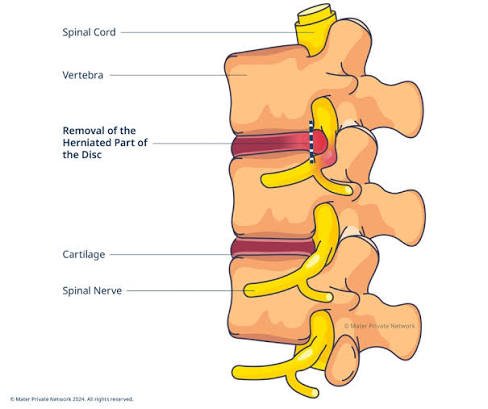
The disc itself does not actually “slip”. The problem is that the bulging material can press on a nearby nerve. That pressure causes the symptoms people notice most:
- Sharp, shooting pain down one leg (sciatica), often worse than the back pain
- Numbness or tingling in the leg or foot
- Weakness — difficulty lifting the foot, walking on heels or toes
- Pain that worsens on sitting, bending, coughing or sneezing
The most common levels are L4-L5 and L5-S1 in the lower back. Slipped discs in the neck (cervical) cause similar symptoms in the arm instead of the leg. If your leg pain started after a slipped disc, you may also find our guide on pinched nerve in the lower back and when surgery helps useful.
Do You Actually Need Surgery?
This is the most important question, and the answer for most people is no — at least not yet.
According to the NHS, a slipped disc usually improves on its own within about 6 weeks to 3 months. The body gradually reabsorbs the herniated material, and the nerve pressure eases. For this reason, first-line treatment is almost always non-surgical:
- Short rest followed by gentle, gradual return to activity
- Pain relief and anti-inflammatory medication, as prescribed
- Physiotherapy focused on core strength and posture
- Nerve root injections (epidural steroid injections) in selected cases
International guidelines such as NICE guidance on low back pain and sciatica support this step-by-step approach. We have written an entire article on this — Slipped Disc: Do You Really Need Surgery? An Honest Guide — because many patients arrive having been advised an operation they do not need.
When surgery is the right choice
Surgery is usually recommended when:
- Leg pain has not improved after 6–12 weeks of proper conservative treatment and is affecting your work, sleep or daily life
- You have progressive weakness — for example, a foot drop that is getting worse
- The pain is severe and uncontrollable even with strong medication
- The MRI clearly matches your symptoms — the disc is pressing on the exact nerve that explains your pain
Emergency warning signs — go to hospital immediately
A large disc can occasionally compress the bundle of nerves at the bottom of the spine (cauda equina syndrome). This is a surgical emergency. Seek urgent care if you have:
- Loss of bladder or bowel control, or difficulty passing urine
- Numbness in the groin, buttocks or inner thighs (“saddle numbness”)
- Sudden weakness in both legs
In these situations, surgery within hours can make the difference between full recovery and permanent damage.
Types of Slipped Disc Surgery
Not every slipped disc operation is the same. The right option depends on the size and position of the disc, your age, whether the spine is stable, and whether there is other narrowing (stenosis). Here are the procedures most commonly offered in Bangalore.
1. Microdiscectomy (microscopic discectomy)
The most common and best-studied slipped disc operation. Through a small incision of about 2–3 cm, the surgeon uses an operating microscope to gently move the nerve aside and remove only the herniated fragment. The healthy disc is left in place.
- Hospital stay: usually 1–2 days
- Anaesthesia: general
- Best for: most single-level lumbar disc herniations
2. Endoscopic discectomy
A narrower tube and a camera (endoscope) are used to reach the disc through an incision of under 1 cm. Muscle disruption is minimal and many patients go home the same or next day.
- Hospital stay: often same day to 1 day
- Best for: selected disc herniations where the position suits an endoscopic approach
- Note: not every disc can be safely removed endoscopically — the choice should be driven by your anatomy, not by the technology
3. Minimally invasive decompression
When the disc herniation comes with narrowing of the spinal canal, the surgeon may also remove thickened ligament or bone to free the nerve. If this applies to you, read more about lumbar spinal stenosis.
4. Spinal fusion (TLIF / MIS-TLIF)
Fusion joins two vertebrae with screws and a spacer. It is not needed for a simple slipped disc. It is considered only when there is spinal instability, a slipped vertebra (spondylolisthesis), or a disc that has herniated repeatedly at the same level.
To understand how small-incision techniques compare with traditional surgery, see our guide on minimally invasive vs open spine surgery, or read about our minimally invasive spine surgery in Bangalore.
Slipped Disc Surgery Cost in Bangalore
Cost is one of the first things families ask about, and it is a fair question. Below are typical ranges seen at established private and super-speciality hospitals in Bangalore for a single-level operation. Your actual cost depends on your specific case and is confirmed only after consultation and review of your MRI.
| Procedure | Typical cost range (single level) | Usual hospital stay |
|---|---|---|
| Microdiscectomy | ₹1,50,000 – ₹3,00,000 | 1–2 days |
| Endoscopic discectomy | ₹2,50,000 – ₹4,50,000 | Same day – 1 day |
| Minimally invasive decompression | ₹2,00,000 – ₹3,50,000 | 1–3 days |
| Lumbar fusion (TLIF / MIS-TLIF) | ₹3,50,000 – ₹6,50,000 | 3–5 days |
What affects the final cost?
- Type of procedure — endoscopic and fusion surgeries cost more than a standard microdiscectomy
- Number of levels — two-level surgery costs more than one
- Implants — only needed for fusion; screw and cage brands vary in price
- Room category — general ward, twin sharing or private room
- Length of stay — longer stays add room, nursing and medication charges
- Pre-operative tests — MRI, blood tests, ECG and anaesthesia evaluation
- Your overall health — diabetes, heart conditions or age may need extra monitoring
Is slipped disc surgery covered by insurance?
In most cases, yes. Medically necessary spine surgery is covered by most Indian health insurance policies, and cashless treatment is usually available at large network hospitals. Points to check with your insurer:
- Waiting periods for pre-existing conditions or specific procedures
- Room rent limits (choosing a higher room category can reduce the claim amount)
- Caps on implant costs for fusion surgery
- Pre-authorisation — the hospital insurance desk usually handles this once the surgeon documents the indication
Tip: Always ask for a written, itemised estimate covering the surgeon’s fee, operation theatre charges, implants (if any), room and expected length of stay. A clear estimate prevents surprises at discharge.
Slipped Disc Surgery Success Rate
When surgery is done for the right reasons — clear leg pain matching a clear disc on MRI — the results are very good.
- Leg pain relief: Published studies on lumbar microdiscectomy commonly report good-to-excellent relief of leg pain in roughly 85–90% of carefully selected patients. Many notice the shooting leg pain is gone as soon as they wake up from surgery.
- Numbness and weakness: These recover more slowly — over weeks to months — because the nerve needs time to heal. Recovery is better when surgery is not delayed too long in patients with progressive weakness.
- Back pain: Surgery is primarily designed to relieve leg pain. Some back pain may persist and usually improves with physiotherapy.
What is the risk of the disc slipping again?
Recurrence at the same level happens in a minority of patients, most often within the first year or two. Commonly reported figures are around 5–10%. Your risk is lower if you:
- Follow the lifting and bending precautions for the first 6 weeks
- Keep your core and back muscles strong with regular exercise
- Maintain a healthy weight
- Stop smoking — smoking reduces blood supply to the disc and slows healing
Is slipped disc surgery safe?
Microdiscectomy is one of the safest operations in spine surgery. As with any procedure, there are risks, which your surgeon should explain before you consent:
- Wound infection (uncommon)
- A small tear in the nerve covering (dural tear), usually repaired during surgery
- Temporary numbness or nerve irritation
- Recurrent disc herniation
- Rare risks of anaesthesia, bleeding or blood clots
The Mayo Clinic’s overview of herniated discs is a good independent reference on the condition and its treatment.
Recovery Time After Slipped Disc Surgery
Recovery is faster than most people expect, especially with minimally invasive techniques. Here is a realistic timeline after a single-level microdiscectomy or endoscopic discectomy.
| Time after surgery | What to expect |
|---|---|
| Same day / Day 1 | Walking with support within hours. Leg pain often much better. |
| Day 1–2 | Discharge home for most patients. |
| Week 1–2 | Short walks several times a day. Avoid long sitting, bending and lifting. Wound check and suture removal. |
| Week 2–4 | Return to desk / IT work for most patients. Begin guided physiotherapy. |
| Week 4–6 | Driving usually allowed once you can brake comfortably and are off strong painkillers. Longer walks. |
| Week 6–12 | Gradual return to gym, sport and physical work under guidance. |
| 3 months | Most patients are back to full normal life. |
After fusion surgery, recovery is longer: expect 4–6 weeks before desk work and around 3–6 months for the bone fusion to become solid.
Tips for a faster, safer recovery
- Walk every day. Walking is the single best exercise after spine surgery.
- Avoid bending, lifting and twisting for the first 4–6 weeks. Do not lift more than 5 kg in the early weeks.
- Limit continuous sitting to 20–30 minutes at a time. Stand and move between sessions — important for IT professionals working long hours.
- Set up your workstation properly. Monitor at eye level, feet flat, lower back supported.
- Start physiotherapy on time and follow the core-strengthening programme.
- Keep follow-up appointments so any concern is caught early.
- Report warning signs immediately — fever, wound discharge, new weakness or bladder problems.
Choosing a Surgeon for Slipped Disc Surgery in Bangalore
Bangalore has many hospitals offering spine surgery. What matters most is not the hospital’s size, but whether the surgeon will tell you honestly whether you need surgery at all. When you meet a surgeon, ask:
- Do my MRI findings match my symptoms?
- Have I had enough conservative treatment?
- Which procedure do you recommend for my disc, and why?
- How many of these procedures do you perform?
- What is the realistic recovery plan for my job?
Our guide on how to choose a neurosurgeon in Bangalore covers this in more detail.
Slipped Disc Treatment at Manipal Hospital Electronics City
Dr. Shyam D is a consultant neurosurgeon at Manipal Hospital Electronics City with over a decade of experience and more than 3,000 surgical procedures. He completed his M.Ch. in Neurosurgery at Madras Medical College with two university gold medals, and trained internationally in Japan, the USA and Türkiye.
His approach to slipped disc treatment is simple:
- Surgery only when it is truly needed — many patients leave the first consultation with a physiotherapy plan, not a surgery date
- Minimally invasive first — microdiscectomy and endoscopic techniques wherever the anatomy allows
- Clear, written cost estimates before any decision
- Direct access — patients can send MRI reports on WhatsApp for review
Patients visit from Electronics City, HSR Layout, Sarjapur Road, Bommanahalli, Hosur Road and across South Bengaluru. Learn more about slipped disc treatment in Electronics City and back pain treatment in Electronics City.
Not sure if you need surgery? Send your MRI report on WhatsApp to +91 63802 71088 for a personal review, or book a consultation with Dr. Shyam D at Manipal Hospital Electronics City.
Frequently Asked Questions
A single-level microdiscectomy in Bangalore typically costs between ₹1,50,000 and ₹3,00,000 at established private hospitals. Endoscopic discectomy usually ranges from ₹2,50,000 to ₹4,50,000, and fusion surgery from ₹3,50,000 to ₹6,50,000. The final cost depends on the procedure, room category and your health, and is confirmed after consultation.
For carefully selected patients whose leg pain matches the MRI findings, microdiscectomy gives good-to-excellent leg pain relief in roughly 85–90% of cases. Numbness and weakness improve more gradually over weeks to months.
Most patients walk the same day, go home in 1–2 days, return to desk work in 2–4 weeks, and resume full activity by about 3 months. Fusion surgery takes longer.
Can a slipped disc heal without surgery?
Yes. Most slipped discs improve within 6 weeks to 3 months with rest, medication and physiotherapy. Surgery is considered when pain persists beyond this, when weakness is getting worse, or in emergencies such as loss of bladder control.
Is slipped disc surgery risky?
Microdiscectomy is one of the safest spine operations. Risks such as infection, dural tear or recurrence are uncommon and are discussed in detail before surgery.
Can the disc slip again after surgery?
Recurrence at the same level happens in around 5–10% of patients. Following activity precautions, strengthening your core, maintaining a healthy weight and avoiding smoking reduce the risk.
Is slipped disc surgery covered by health insurance in India?
Most Indian health insurance policies cover medically necessary spine surgery, and cashless treatment is available at major network hospitals. Check your policy’s waiting periods, room rent limits and implant caps.
This article is for general information and does not replace a personal medical consultation. Every patient’s spine is different — please consult a qualified spine surgeon before making treatment decisions.
3 Comments