Few pains get your attention like sciatica. It’s that sharp, shooting, sometimes electric pain that runs from your lower back or buttock down the leg — and for many people it arrives out of nowhere and makes sitting, standing, and sleeping miserable. The good news, which gets lost in the panic, is that most sciatica improves on its own within weeks and never needs surgery. This guide explains what sciatica actually is, what causes it, how to relieve it, and the specific signs that mean it’s time to see a specialist.
What is sciatica?
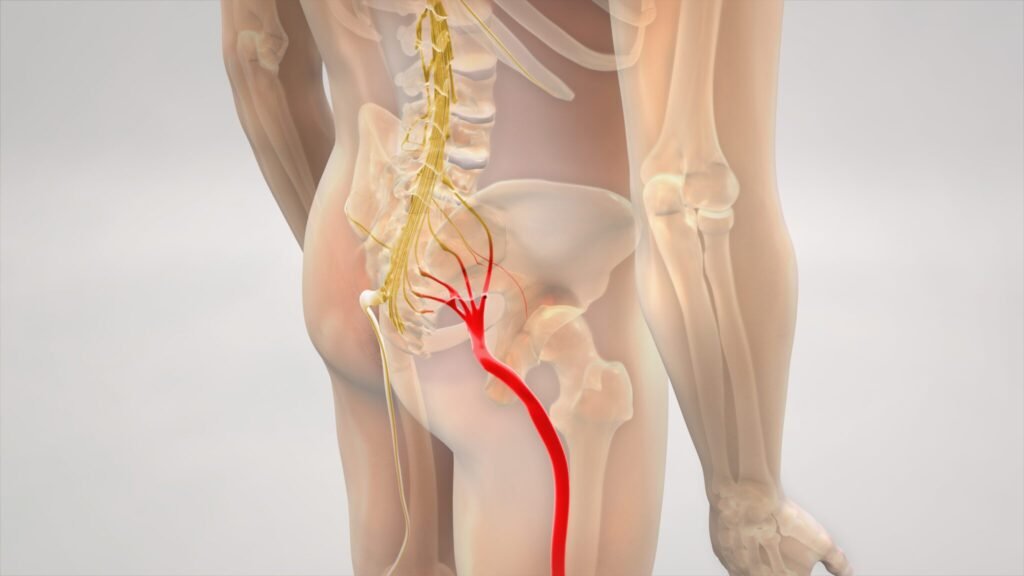
Sciatica isn’t a diagnosis in itself — it’s a symptom. The word describes pain that travels along the path of the sciatic nerve, the largest nerve in your body, which runs from your lower back through your buttock and down the back of each leg to the foot.
When something presses on or irritates this nerve (or the nerve roots that feed into it in your lower spine), you feel pain, tingling, or numbness anywhere along its path. So “sciatica” tells you which nerve is affected — the job of assessment is to work out what’s pressing on it.
What sciatica feels like
Sciatica has a fairly recognisable pattern that sets it apart from ordinary back pain:
- Pain that radiates from the lower back or buttock down the back of the leg — often past the knee, sometimes to the foot
- Usually one-sided — most people feel it in one leg
- Sharp, burning, shooting, or electric in quality — not a dull ache
- Leg pain often worse than the back pain — many people barely notice their back, it’s the leg that’s unbearable
- Tingling or “pins and needles” in the leg or foot
- Numbness along a band of the leg or foot
- Weakness in the leg or foot in more significant cases
- Worse with sitting, coughing, sneezing, or bending forward
The travelling, one-sided, electric quality is the giveaway. A general ache staying in the back is usually mechanical back pain; pain shooting down one leg points to a nerve.
What causes sciatica?
Sciatica happens when a nerve root in the lower spine is compressed or irritated. The common causes:
Herniated (slipped) disc — the most common cause When the soft cushion between two vertebrae bulges or ruptures, it can press directly on a nerve root. This is behind the majority of sciatica cases, especially in younger and middle-aged adults. See our guide on slipped disc treatment.
Lumbar spinal stenosis Age-related narrowing of the spinal canal crowds the nerves, and is a common cause of sciatica in older adults — often with the classic pattern of leg pain that eases when you bend forward. See lumbar spinal stenosis.
Degenerative disc disease and bone spurs Wear-and-tear changes and bony overgrowths from spinal arthritis can narrow the space around a nerve.
Spondylolisthesis When one vertebra slips forward over another, it can pinch a nerve.
Piriformis syndrome Less commonly, the piriformis muscle deep in the buttock can irritate the sciatic nerve directly.
Rarer causes Occasionally, a tumor, infection, or injury is responsible — uncommon, but part of why persistent or unusual sciatica deserves assessment.
Who gets sciatica?
Several things raise the risk:
- Age — disc and spine changes become more common from the 30s onward
- Prolonged sitting — desk jobs and long commutes are a major factor
- Heavy or awkward lifting — especially twisting while lifting
- A sedentary lifestyle with weak core and back muscles
- Being overweight, which adds load to the spine
- Diabetes, which can affect the nerves
- Occupations involving heavy manual work or long driving
The good news: most sciatica gets better on its own
This is the part worth holding onto if you’re in the middle of it. The large majority of sciatica caused by a herniated disc improves substantially within 6 to 12 weeks without surgery. The body often gradually reabsorbs the herniated disc material, and the inflammation around the nerve settles.
That doesn’t mean you have to just suffer through it — there’s a lot you can do to manage the pain and support recovery.
How to relieve sciatica
First-line treatment is about controlling pain and staying mobile while the nerve settles:
- Stay gently active — this is the single most important thing. Prolonged bed rest actually slows recovery and stiffens everything. Keep moving within the limits of your pain.
- Physiotherapy — targeted exercises, stretches, and core strengthening genuinely help, both to recover and to prevent recurrence.
- Pain-relieving and anti-inflammatory medication to manage flare-ups.
- Nerve-specific medication for the burning, electric quality of nerve pain.
- Heat or ice for symptom relief.
- Adjusting your setup — a better chair, standing breaks, and attention to posture during the recovery period.
For stubborn cases:
- Epidural steroid injections can reduce inflammation around the irritated nerve and provide a window of relief that lets rehabilitation progress.
Simple self-care that helps
While the nerve settles, these habits make a real difference:
- Take regular breaks from sitting — stand and walk every 30–45 minutes
- Avoid heavy lifting and twisting while in pain
- Keep gently active rather than resting completely
- Use a supportive chair and set up your desk ergonomically
- Sleep in a position that eases your leg — many find relief with a pillow between or under the knees
- Build core strength once the acute pain settles, to reduce the chance of it returning
Red flags: when sciatica is an emergency
Most sciatica is safe to manage patiently. But a few symptoms are genuine emergencies. Seek medical care immediately if you have:
- Loss of bladder or bowel control, or numbness around the groin, inner thighs, or buttocks (the “saddle” area)
- Severe or rapidly worsening weakness in the leg or foot — for example, a foot that drags or can’t lift
- Sciatica in both legs at once
- Sciatica following a significant injury
These can indicate a serious condition called cauda equina syndrome, which needs urgent surgery to prevent permanent damage. It’s rare — but this is the one situation where waiting is genuinely dangerous.
When to see a specialist
Outside of emergencies, consider seeing a spine specialist if:
- Sciatica is severe or hasn’t improved after a few weeks of proper self-care
- You have significant or worsening numbness or weakness in the leg or foot
- The pain is seriously disrupting your work, sleep, or daily life
- Sciatica keeps coming back
- You’ve had a scan showing a disc or nerve problem and want to understand your options
A specialist can confirm exactly what’s compressing the nerve, rule out anything serious, and put together a plan — which, for most people, still means non-surgical treatment. If you’re unsure whether to see a neurologist or a neurosurgeon, our guide on when to see a neurosurgeon vs a neurologist explains the difference.
When sciatica needs surgery
Surgery becomes the right conversation when severe leg pain persists despite 6–12 weeks of proper treatment, when there’s significant or progressive weakness, or urgently if red-flag symptoms appear.
The most common procedure is a discectomy — removing the fragment of disc pressing on the nerve to free it up. When the cause is stenosis or bone, a decompression reopens space around the nerve. Both are frequently done minimally invasively, through a small incision using a tubular retractor and microscope, which usually means less pain and a faster recovery than open surgery. You can read more on our minimally invasive spine surgery page.
Relief of leg pain after a well-indicated discectomy is often rapid — many people notice the shooting pain is gone as soon as they wake up. The key principle throughout: surgery is guided by how you’re doing and whether a scan matches your symptoms — not by the scan alone. Many people have disc bulges on MRI with no pain at all.
How sciatica is diagnosed
Diagnosis usually combines:
- Your history and symptom pattern — the travelling, one-sided leg pain is often diagnostic on its own
- A physical and neurological examination — testing strength, sensation, reflexes, and nerve tension
- An MRI scan — used when symptoms are severe, persistent, or a specialist needs to see exactly what’s compressing the nerve before considering injections or surgery
Not everyone with sciatica needs a scan — most cases are diagnosed clinically and improve before imaging is ever needed.
Frequently asked questions
Most sciatica improves within 6–12 weeks. Many milder cases settle within days to a few weeks. Persistent or worsening sciatica beyond this deserves specialist assessment.
Staying gently active, anti-inflammatory or nerve-specific medication, physiotherapy, and heat/ice help most people. Complete rest tends to slow recovery. For stubborn pain, an epidural steroid injection can provide relief. There’s no instant cure, but most people improve steadily.
No. The large majority of sciatica improves without surgery. Surgery is needed only in a minority — mainly when severe leg pain persists despite proper treatment, or when there’s significant weakness.
Can sciatica go away on its own? Yes. Most sciatica caused by a herniated disc resolves on its own within weeks as the inflammation settles and the disc material is reabsorbed.
When should I worry about sciatica? Seek urgent care if you have loss of bladder or bowel control, saddle numbness, severe or worsening leg weakness, or sciatica in both legs — these can signal a serious condition needing immediate treatment.
What’s the difference between sciatica and normal back pain? Normal back pain usually stays as an ache in the back. Sciatica travels down the leg, often past the knee, with a sharp, burning, or electric quality, frequently with tingling or numbness — because a nerve is involved.
Get an expert opinion
If sciatica is severe, not settling, or coming with numbness or weakness — or if you’re simply worried — a proper assessment can tell you what’s causing it and what to do. Book a Consultation · Send Reports on WhatsApp · +91 63802 71088
This article is for general information and is not a substitute for professional medical advice. Loss of bladder or bowel control, saddle numbness, or rapidly worsening weakness needs immediate medical care.